


Is Renting Better Than Buying Property in Gurgaon?
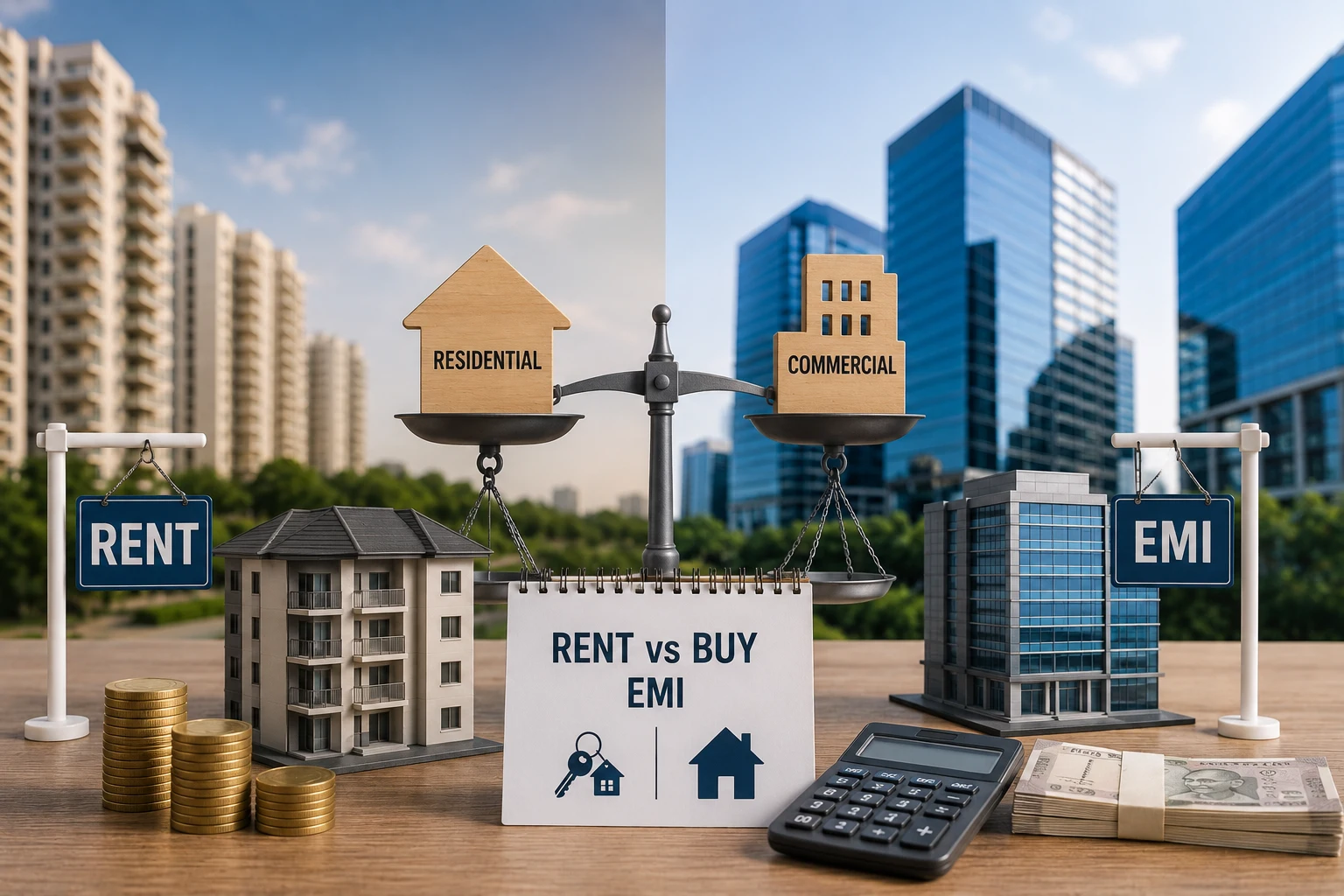
Gurgaon's property prices keep climbing, and so do rents. So the question every working professional, investor, and family eventually asks is simple: should you keep paying rent, or start paying an EMI instead?
Here's the short answer that most people get wrong: yes, rent is almost always cheaper than EMI on a month-to-month basis. But cheaper isn't the same as better. Renting keeps more cash in your pocket today — it just doesn't build you anything for tomorrow.
This guide breaks down rent vs. EMI for both residential homes and commercial property in Gurgaon, using real numbers, so you can see exactly where each choice wins and where it quietly costs you.
Gurgaon Real Estate Snapshot 2026
Before comparing rent and EMI, here's the market context:
- 1. Residential rental yields sit around 2.5% to 4.5%, while commercial yields run 6% to 12%.
- 2. Home loan interest rates are near a multi-year low, starting around 7.10–7.50% for strong credit profiles, with most borrowers landing between 7.65% and 8.50%.
- 3. Stamp duty and registration in Haryana add roughly 5–7% to the upfront cost of buying.
- 4. Corporate hiring in Cyber City, Golf Course Road, and Udyog Vihar keeps both rental and buying demand strong.
This is why the rent vs. EMI questions play out very differently depending on whether you're renting or buying a home to live in, or a commercial space as an investment.
Renting a Home in Gurgaon: Cost, Benefits & Reality
Renting is the default choice for most professionals moving to Gurgaon for work.
Advantages of Renting
- Lower monthly outgo than an equivalent EMI
- No big down payment or stamp duty
- Easy to relocate if your job or life situation changes
- Maintenance is usually the landlord's responsibility
- Access to premium localities you may not be able to afford to buy in
Disadvantages of Renting
- No ownership — the property never becomes yours
- No returns — your rent generates zero financial upside for you
- Rent increases nearly every year, often 5–10%
- Long-term cost adds up significantly with nothing to show for it
Renting is ideal if you value flexibility or aren't sure how long you'll stay in Gurgaon.
Buying a Home on EMI in Gurgaon: Cost, Benefits & Reality
Buying is a long-term decision built around stability and asset creation.
EMI Cost Example (2026)
- Property price: ₹1 crore
- Down payment (20%): ₹20 lakh
- Loan amount: ₹80 lakh
- EMI (20–25 years, ~8% rate): ₹62,000 – ₹68,000/month
This EMI will usually be higher than rent for a similar property — but unlike rent, this monthly outgo builds equity in an asset you own.
Advantages of Buying on EMI
- You build ownership and equity with every payment
- Property value can appreciate over time, especially in maturing corridors
- You can rent it out later for additional income
- EMI functions as forced savings — money you'd otherwise spend gets locked into an asset
- No landlord, no rent hikes, no relocation notice
Disadvantages of Buying
- Higher upfront cost: down payment, stamp duty, registration
- A long-term financial commitment, typically 15–25 years
- You bear maintenance and property tax directly
- Less flexibility if you need to relocate quickly
Buying makes sense if you plan to stay long-term and want to build an asset instead of just paying for shelter.
Residential Rent vs EMI: The Real Trade-off
Yes, the monthly rent is normally cheaper than the EMI — but renting does not lead to ownership or generate returns. That's the entire trade-off in one line. Every rupee of rent disappears the moment you pay it. Every rupee of EMI (beyond the interest portion) builds equity that's yours to keep, sell, or pass on.
The math only tips toward buying, though, when you stay long enough for appreciation and equity to outweigh the extra monthly cost, stamp duty, and reduced flexibility. Under 5 years, renting usually wins. Beyond 7–10 years, buying usually wins — even though the EMI felt like the more expensive option every single month along the way.
Commercial Rent vs EMI in Gurgaon: A Different Game
Commercial property flips this entire equation.
Where residential rental yields (2.5–4.5%) sit well below home loan rates (7.65–8.50%), commercial yields in Gurgaon often run 6% to 12% — frequently matching or beating the cost of borrowing. Grade-A offices, pre-leased retail, and SCO plots on corridors like Golf Course Extension Road, Dwarka Expressway, and SPR sit toward the higher end of that range.
What this means practically
- 1. A well-tenanted commercial property can generate rent that covers its own EMI from day one — something residential property almost never does in Gurgaon.
- 2. Lease terms are longer and more predictable, often 9 years with built-in rent escalations of around 15% every three years.
- 3. Tenant quality matters enormously — bank branches, MNCs, and established retail brands rarely vacate, which protects your cash flow.
- 4. Leasing commercial space (instead of buying) still makes sense for businesses that need flexibility to scale up, downsize, or relocate as they grow — buying locks you into one location and one footprint.
Buying vs. Leasing Commercial Space
Buy if the yield clearly covers your financing cost, the tenant profile is strong, and you're building a long-term income asset.
Lease if your business needs may change in the next 3–5 years, or if the upfront capital and due diligence required for ownership (RERA compliance, developer track record, lease structuring) isn't worth it yet.
Conclusion
Residential: Renting is cheaper monthly and more flexible, but builds nothing. Buying on EMI costs more every month but builds equity, and pays off once you stay long enough for appreciation to do its work.
Commercial: The yield gap that makes residential buying hard to justify often disappears here. When commercial rent can cover the EMI, ownership pays for itself, provided the tenant and lease quality hold up.
The right decision isn't about which option feels cheaper today — it's about whether you're optimizing for flexibility right now, or ownership and returns over time.
Also Read: What's the Average Property Price Per Sq Ft in Gurgaon?
FAQs
Q1. Is renting less expensive than paying an EMI in Gurgaon?Yes. In most cases, monthly rent is lower than an EMI. However, rent does not build ownership, while EMI payments gradually help you own the property.
Q2. Is renting better than buying commercial property in Gurgaon?Not always. Commercial properties often offer higher rental yields, which can cover a large part of the EMI. Buying can be more rewarding if you choose the right location and tenant.
Q3. Should I rent or buy a home if I'm working in Gurgaon?If you plan to stay in Gurgaon for many years, buying can help you build wealth. If your job or location may change soon, renting offers more flexibility.
Q4. What is considered a good rental yield for commercial property in Gurgaon?A rental yield of 8% or more is generally considered good, especially for properties leased to reputed companies on long-term agreements.
Q5. Can I rent a property first and buy later?Yes. Renting first gives you time to save for a down payment, understand the local market, and decide on the right property before making a long-term investment.